Mechanical Design

What Mechanical Design Encompasses

Mechanical design turns what a product has to do into parts that move, hold up, and can be built. It covers the enclosures and structures that hold electronics, the moving parts inside and around them, products where the mechanical design does most of the work, and the research, analysis, prototyping, and design for manufacturing behind them. At PDE the mechanical designers work in the same team as the industrial designers, electronics designers, and firmware developers, so any electronics a product needs are designed together with the parts around them.

  • Research & Definition

    Know what the product has to do, and for whom, before any geometry is drawn.

    • Competitive analysis
    • User studies
    • Human factors & ergonomics
    • Product architecture
  • Detailed Design

    Enclosures, moving parts, and products, designed with any electronics and firmware they hold or drive.

    • Rugged, sealed enclosures
    • Drop and shock resistance
    • Moving parts & motorized assemblies
    • Electromechanical integration
    • Mechanical products
    • Structures and frames
  • Analysis & Prototyping

    Check heat and loads in CAD, then prove the design in hand.

    • Thermal analysis
    • Stress analysis
    • FDM and resin printing
    • Machined prototypes
    • Evaluation with users
  • Design for Manufacturing

    Every part, even a prototype, designed for the process that will make it.

    • Injection and compression molding
    • Die casting
    • Machining
    • Sheet metal and weldments
    • Paint and plating
    • Vendor connections
Enclosures

Rugged, Waterproof Enclosures

PDE designs sealing and drop performance into the enclosure from the first CAD model, treating every opening as its own sealing problem. Battery doors, display windows, buttons, and connector ports are where sealed enclosures usually leak. Wall thickness, rib geometry, and material choice decide whether a housing survives a drop. On the Eaton TD3100, PDE delivered an IP67 enclosure built to survive a 2-metre powered drop onto concrete.

  • Every opening: battery compartments, display windows, control cutouts, and connector ports each need their own seal. One weak interface fails the rating for the whole assembly.
  • Access points: battery doors have to reseal every time they close, survive repeated cycles, and still be easy to operate in the field.
  • Drop performance: wall thickness, internal rib geometry, and material selection determine whether the housing absorbs an impact or cracks.
  • Built for the hand: on the Eaton TD2100 pistol grip, a recess in the housing lets the operator's thumb reach the bottom row of buttons without shifting their grip, and the TD1140 pendant's narrower back section reduces the effective size of the enclosure, making it easier to grip.
  • Built around the board: the board outline, connectors, controls, displays, and heat sources set the envelope the enclosure has to work around.

Eaton came to PDE with preliminary circuit board designs for the updates to its TD3100 belly-pack controller. The addition of a display, menu buttons, and a removable battery pack called for a new sealing strategy from the ground up, with a separate sealing analysis for each interface to reach IP67 across the assembly. Drop performance was addressed through the choice of wall thickness and an impact-resistant housing material. The IP67 removable battery pack was carried across the TD2100 and TD1140, and a contactless charging cradle, which avoids exposed battery contacts, completes the system.

The Eaton TD3100 wireless belly-pack controller, an IP67-rated, drop-rated enclosure designed by PDE
Beyond the Enclosure

When the Mechanical Design Is the Product

PDE’s mechanical designers work on products whose mechanical design decides how well they work. Kensington’s TurboRing and Expert Mouse trackballs are defined by how the ball and Scroll Ring move and feel under a fingertip. The same work applies to fitness and training equipment, sporting goods, tools, and consumer products, where there may be a sensor or a motor inside but the movement, feel, and durability decide whether the product works.

In these products the hard problems are mechanical: how a part moves and whether it keeps moving the same way after years of use, how it feels in the hand, what load it carries, and whether it survives being dropped, struck, or pulled thousands of times. Any sensors, batteries, or motors are designed around those decisions.

  • Trackballs: PDE did the mechanical design for Kensington's TurboRing, the first trackball with a rotating Scroll Ring around the ball, and its successor the Expert Mouse, built around a 55 mm ball.
  • Gamepads: the pocket-sized Kensington Stinger fit ten buttons and an analog thumbstick into a laptop gamepad.

PDE's mechanical designers also take on fitness and training equipment, sporting goods, tools, and other products where a moving part, a cord, a hinge, or a spring does the real work. If the hard part of your product is how it moves, how it feels, or what it has to survive, with a little electronics inside or none at all, it's work we want to do.

Analysis

Thermal Design: Getting the Heat Out

Find where the heat comes from, design a path to move it out of the product, and check that path in thermal analysis before anything is machined or tooled. Depending on the product, that path can be a custom heat sink, vents and managed passive airflow, or, when active cooling is needed, a fan. Physical prototypes then confirm what the analysis predicts.

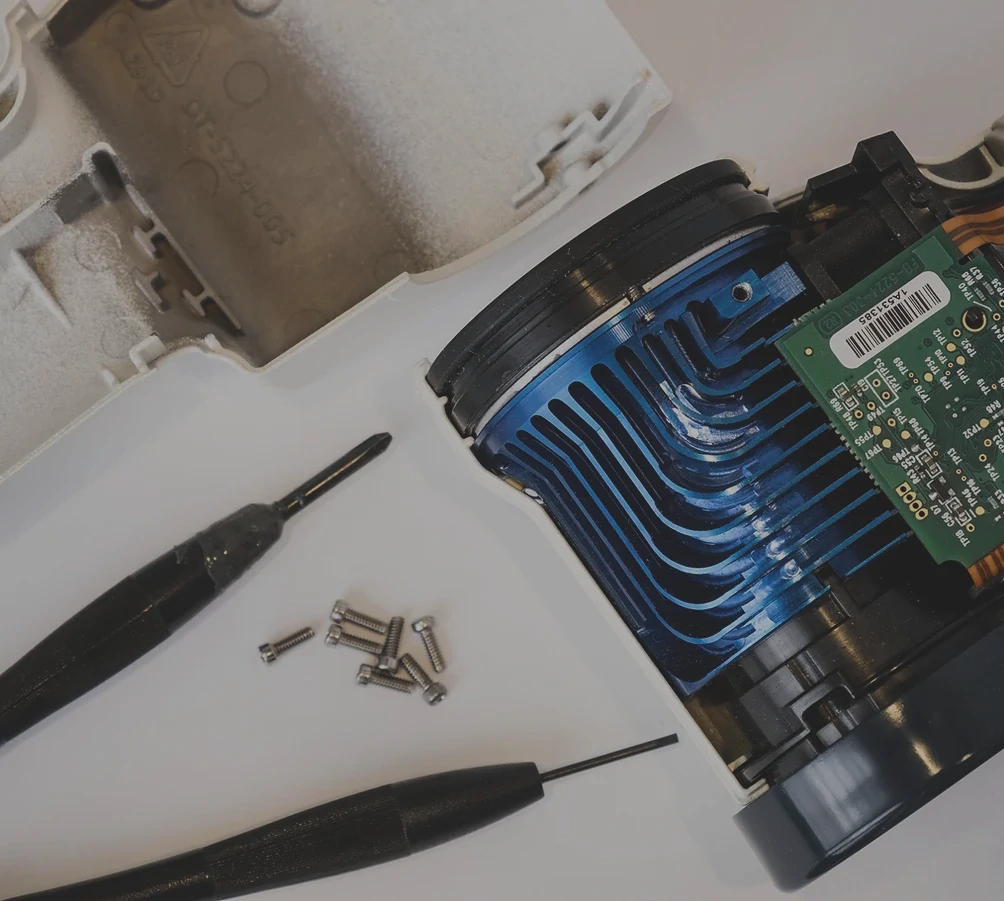
The VELscope Vx had to dissipate the heat of many ultraviolet LEDs and be small and light enough to hold in one hand near a patient's face, all while being easy to clean and sterilize. PDE designed a custom heat sink that wraps the cooling fins and air path around the central optical tube and channels exhaust air down through the handle, optimized through thermal simulation and produced by 4-axis machining.

On the RetailNext Aurora, an internal fan and custom heat sink handle the onboard processing load, with vents at each end of the base so no grilles appear on the visible face.

An opened VELscope Vx showing the custom machined heat sink PDE designed around its optical tube
Manufacturing

Design for Manufacturing From the Start

Every physical product PDE designs, even a prototype, has to be manufactured, so the process each part will be made with shapes its design from the first review. A part designed without its process in mind has to be redesigned before it can be tooled. Molded plastics, die castings, machined parts, sheet metal, and weldments each have their own manufacturing requirements, such as wall thickness, draft angle, or tolerances. PDE designs for all of them.

  • Injection and compression molding: plastic and elastomer parts for high-volume manufacturing, where consistent wall thickness, draft, and design details that deal with undercuts keep tooling cost down.
  • Die casting: high-volume metal parts that need stiffness, precise alignment, or heat conduction.
  • Machining: precise metal and plastic parts, heat sinks, and lower-volume parts that don't justify the expense of a tool.
  • Sheet metal and weldments: frames, brackets, chassis, and larger structures.
  • Finishing: paint, plating, and other finishes specified so parts meet the client's environmental protection and appearance requirements.

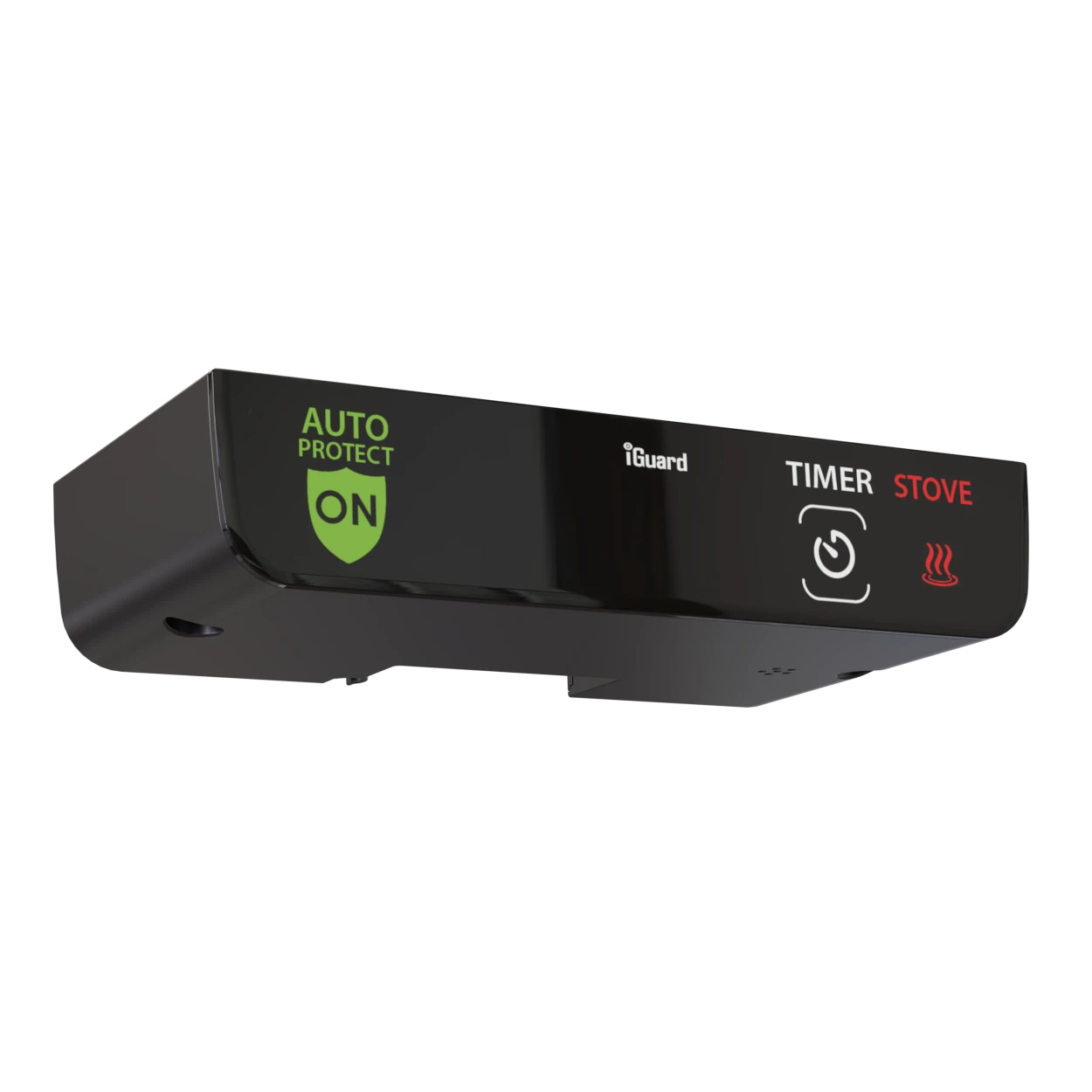
For iGuard, PDE produced injection-molded parts qualified for production tooling, along with test procedures and assembly documentation.

From the Portfolio

More Mechanical Work

TD1140
Industrial

TD1140

The Eaton TD1140 is a pendant-style wireless machine control in the TD1100 series. A variant built for operators who need a full button layout in a form factor that stays comfortable across a long shift.
View Case Study
Portable Conference Phone
Telecommunications

Portable Conference Phone

The Polycom Portable Conference Phone extends the reliability of Polycom’s professional conference audio into a battery-powered, cable-free form factor suited for ad hoc meetings, huddle spaces, and mobile collaboration. Built around Polycom’s omnidirectional microphone array and HD voice processing, it delivers boardroom-grade audio clarity without the constraints of a fixed room installation.
View Case Study
FAQ

More Questions We Get Asked

What kinds of products does PDE do mechanical design for?

Electronic products that need a rugged enclosure, electromechanical devices, and products where the mechanical design does most of the work, across consumer, industrial, agricultural, and medical markets. Examples include the Kensington TurboRing and Expert Mouse trackballs and the Stinger gamepad, body-worn and handheld machine controls such as the Eaton TD3100, and a handheld medical imaging device in the VELscope Vx.

Does PDE design fitness equipment, sporting goods, or tools?

Yes. In products like these the mechanical design does most of the work, with perhaps a sensor, a battery, or a small motor inside, and the hard problems are mechanical ones: surviving repeated impact and load, how the product feels in use, and keeping cost down at volume. PDE prototypes early with printed and machined parts so the feel can be judged in hand, and designs each part for the process that will make it. When the product needs electronics or firmware, the same team designs those too.

Does PDE do mechanical design without also building the electronics?

Yes. Many PDE engagements are mechanical-only: a new product from an idea, a motorized feature added to a product already on the market, an enclosure for a board that already exists, or detailed design for an industrial design from another studio. PDE did mechanical design for Kensington’s TurboRing and Expert Mouse trackballs, and Eaton came to PDE with preliminary circuit board designs for its TD3100 update. PDE also develops mechanical, electronics, and firmware together in one team when a project needs all three.

What kinds of mechanisms has PDE designed?

Examples include the rotating Scroll Ring around the ball of the Kensington TurboRing, the first trackball to use one.

What manufacturing processes does PDE design parts for?

Plastic injection molding and compression molding, die casting, machining, sheet metal, weldments, and rapid prototyping, along with finishing methods such as paint and plating. The right process depends on what the part has to do and how many are being made, and one product often uses several: the RetailNext Aurora pairs a molded plastic body with a die-cast aluminum base that holds its stereo cameras at a fixed separation.

Can PDE help me find someone to manufacture my parts?

Yes. PDE works with a network of vendors who can make parts in just about any manufacturing process, including machining, injection molding, die casting, sheet metal, and welding, and can connect you with ones suited to your part.

What do IP66 and IP67 ratings mean for an enclosure?

An IP (Ingress Protection) rating has two digits: the first covers solid particles and dust, the second covers water. A 6 in the first position means dust-tight. A second digit of 6 means protection against powerful water jets, and a 7 means protection against temporary submersion, typically up to 1 metre. The two water tests are separate, so an IP67 enclosure isn’t automatically IP66, and a product that needs both has to be designed and tested for both. PDE designed the IP67 enclosures of Eaton’s TD3100, TD2100, and TD1140 controllers.

What CAD, analysis, and prototyping tools does PDE use?

PDE does mechanical design in SolidWorks, uses thermal analysis and FEA stress analysis to check designs before they are built, tests sealing in an in-house immersion tank, and makes prototypes with FDM and resin printing. Heat sinks and other metal parts can be produced by 4-axis machining, as on the VELscope Vx.

Where is PDE located, and do you work with clients outside Vancouver?

PDE is based in Burnaby, BC, in Greater Vancouver, and works with clients throughout North America. A hybrid model and an in-house design lab support both remote and in-person collaboration, including review of physical prototypes.

How does mechanical design relate to PDE's other services?

Industrial Design leads form, colour, material, and finish, and shares the early research and architecture work with Mechanical Design. Mechanical Design turns that into the parts, moving assemblies, and structure that make the product work and get it built. Electronics Design and Firmware provide the boards, motors, sensors, and control logic the mechanical design holds and drives, and mechanical decisions such as grounding and shielding also affect Compliance & Certification results. For products that need all of these developed together, see Full Service Product Development.