Our Design Process

What Is the Industrial Design Process?

PDE’s industrial design process has six phases: Discovery, Ideation, Concept Development, Prototyping and Testing, Detailed Design, and New Product Introduction. Ideation, concept development, and prototyping repeat as a loop until a direction holds up in hand and with users. Because the same team does the mechanical design, the approved look goes to tooling as complete part models, not as a surface model someone else has to interpret.

Leading Supporting Commitment
Industrial design
Client & users
  1. Discovery. Define the problem the product solves, who uses it, where it lives, and what it should say about the technology inside. Product, functional, and user requirements are written down, and a competitive analysis shows what the product has to stand apart from. You get: a design brief, design language direction, and mood boards.

    Industrial design: leading Electronics: supporting Client & users: leading
  2. Ideation. Hand sketches explore form and product architecture. CAD massing models check that each direction fits the real product envelope, and cardboard, foam, or 3D printed mock-ups put the size and proportion in front of you early. You get: a range of form directions and preliminary colour, material, and finish (CMF) studies.

    Industrial design: leading Mechanical: supporting Electronics: supporting Client & users: supporting
  3. Concept development. The strongest directions are narrowed to a few candidates, and their form and colour details are refined in CAD. You get: photo-realistic renderings of each candidate, so the choice between them is made on how the product will actually look.

    Industrial design: leading Mechanical: supporting Electronics: supporting Client & users: supporting
  4. Concept selected

    Prototyping and testing. Full-size models are 3D printed or machined so form and ergonomics can be judged in hand rather than on screen. Users evaluate and test them, and what they find feeds back into ideation and concept development until the design holds up. You get: a validated form, with ergonomics checked by the people who will use it.

    Industrial design: leading Mechanical: supporting Electronics: supporting Client & users: leading
  5. Design approved

    Detailed design. The approved design is modelled in CAD for manufacturing, with materials, tolerances, and the final CMF specified. Rapid prototypes check fit and assembly before tooling. This work happens alongside Mechanical Design, so sealing, heat, and structure are resolved without losing the design intent. You get: a final CMF specification and a manufacturing documentation package.

    Industrial design: leading Mechanical: leading Electronics: supporting Client & users: supporting
  6. Released for tooling

    New product introduction. PDE works with your vendors through tooling, makes DFM adjustments where the factory needs them, and checks first articles for appearance, fit, and assembly. You get: production parts that match the design you approved.

    Industrial design: supporting Mechanical: leading Client & users: supporting
Illustrative. Ideation, concept development, and prototyping repeat until a direction holds up in hand and with users. Timing varies from project to project.
The Process in Practice

Discovery: Writing the Right Brief

Most of what makes an industrial design succeed is decided before the first sketch. Discovery turns where the product lives, who handles it, and what it competes with into a written brief that every later direction is judged against.

  • Where it lives: the RetailNext Aurora brief asked for a sensor that would blend into a retail ceiling and stay as compact as possible.
  • What it competes with: the same brief required clear differentiation from a competing two-camera device already on the market.
  • Who uses it: the iGuard redesign was written around aging-in-place seniors, including people living with dementia, and a home that should not look like it holds a safety device.
The Process in Practice

Ideation and Concept: From Sketch to Rendering

Ideation is deliberately wide: hand sketches, massing models, and quick mock-ups test many directions cheaply. Concept development narrows them to a few and refines form, colour, and detail in CAD until they can be rendered and compared.

  • Form with a reason: the Fathom Hub uses a hexagonal footprint that reflects the device's omnidirectional function, and an illuminated logo that echoes the hexagon.
  • CMF that does work: on the Fathom Hub, a textured top against polished side walls breaks up the volume. On iGuard, a tinted dead-front faceplate reads as a blank surface when idle and reveals the capacitive touch controls only when they're needed.
  • The user interface: iGuard's user interface flow was worked out as a flowchart, which gave the client a clear reference for discussion and gave the firmware team a specification to build from.
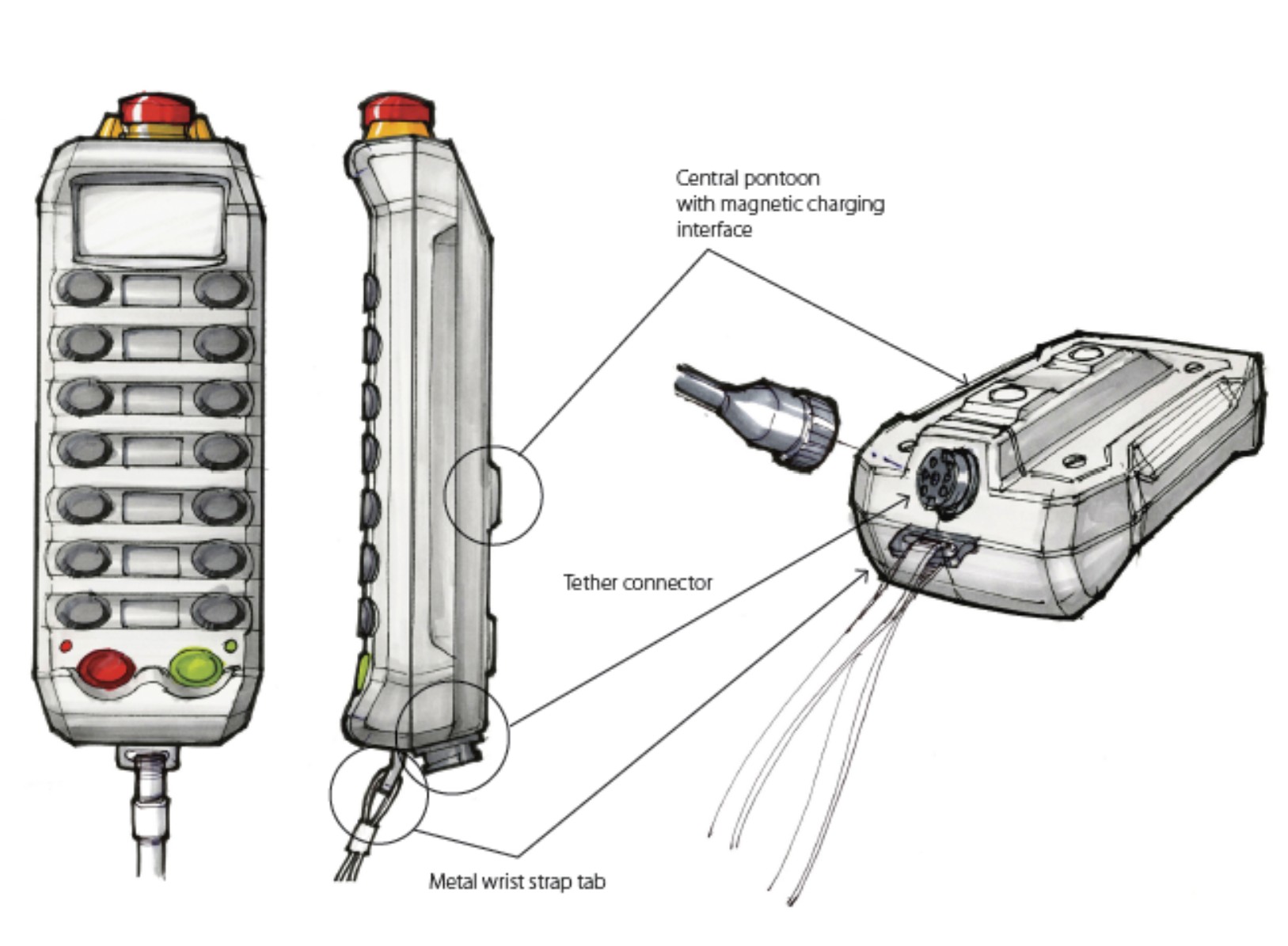
Industrial design sketch of the Eaton TD1140 wireless pendant control
The Process in Practice

Prototyping and Testing: Proving It in Hand

A rendering can't tell you whether a controller is comfortable at the end of a shift. Full-size printed and machined models can, and they put the design in front of real users while changes are still cheap.

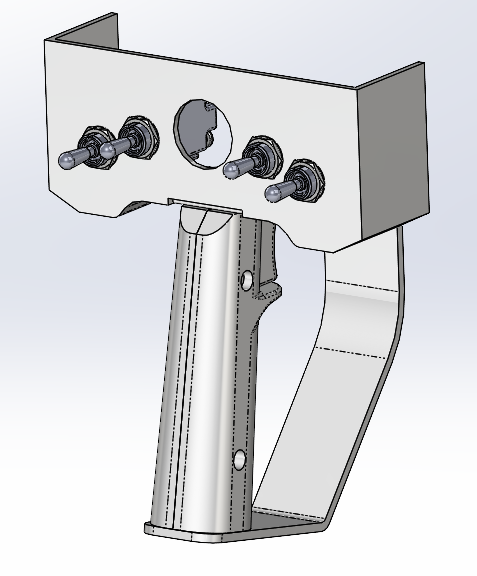
  • Reach: on the Eaton TD2100, a recess in the housing lets the operator's thumb reach the bottom row of buttons without breaking grip, with the recess depth balanced against the strength of the housing wall.
  • Contact: on the Eaton TD1140 pendant, a narrower back profile reduces the surface pressing against the operator's body.
  • Continuity: across the Eaton controller family, the redesigns kept the brand identity operators already knew and trusted while adding IP67 sealing, drop survival, and a modular battery pack.
Mockup of the Eaton TD2100 to test the thumb switch reach case.
Detailed Design and Production

Industrial vs. Mechanical Design: What's the Difference?

Industrial design decides what a product looks like, how it feels in the hand, and how people use it. Mechanical design makes that form buildable. Industrial design covers form, proportion, ergonomics, colour, material, and finish. Mechanical design covers the wall thicknesses, sealing, thermal paths, and internal structure that let the form be molded, assembled, and survive real use. At PDE the same team does both, so trade-offs get settled in one design review instead of passed back and forth between firms.

  • Industrial design answers: What should this look like? How does it feel to hold, wear, or install? What does it communicate about the technology inside? Which colours, materials, and finishes fit where it will be used?
  • Mechanical design answers: How is it molded and assembled? How does it seal against dust and water? Where does the heat go? Will it survive a drop?
  • Where they meet: most of the hard decisions involve both. The answer that satisfies one discipline often costs the other something, so the two need to be resolved together.

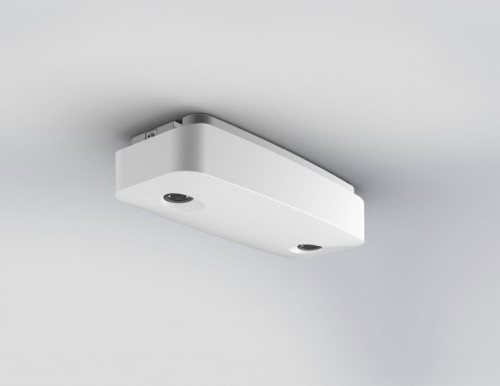
On the RetailNext Aurora, a narrow die-cast aluminum base makes the sensor look like it floats below the ceiling, and the same base holds the stereo cameras at a fixed, precise separation and leaves room for vents at each end. One design decision did industrial and mechanical work at once.

The RetailNext Aurora ceiling-mounted retail sensor, industrial and mechanical design by PDE
Already Have a Design?

Taking an Existing Design to Production

PDE takes industrial designs from a client’s own team or another studio through to production. PDE picks up the process at Detailed Design, designs the enclosure, electronics, and firmware around the design, flags early where it conflicts with manufacturing, and proposes options that keep the design intent intact.

An industrial design usually meets manufacturing at a few predictable points: where seals and parting lines fall, how heat leaves the enclosure, where buttons, displays, connectors, and batteries fit, and whether wall thickness and undercuts can be tooled as drawn. We learn which features define the design and which have room to move, check them against these constraints before detailed design starts, and bring options rather than overrides where something has to change.

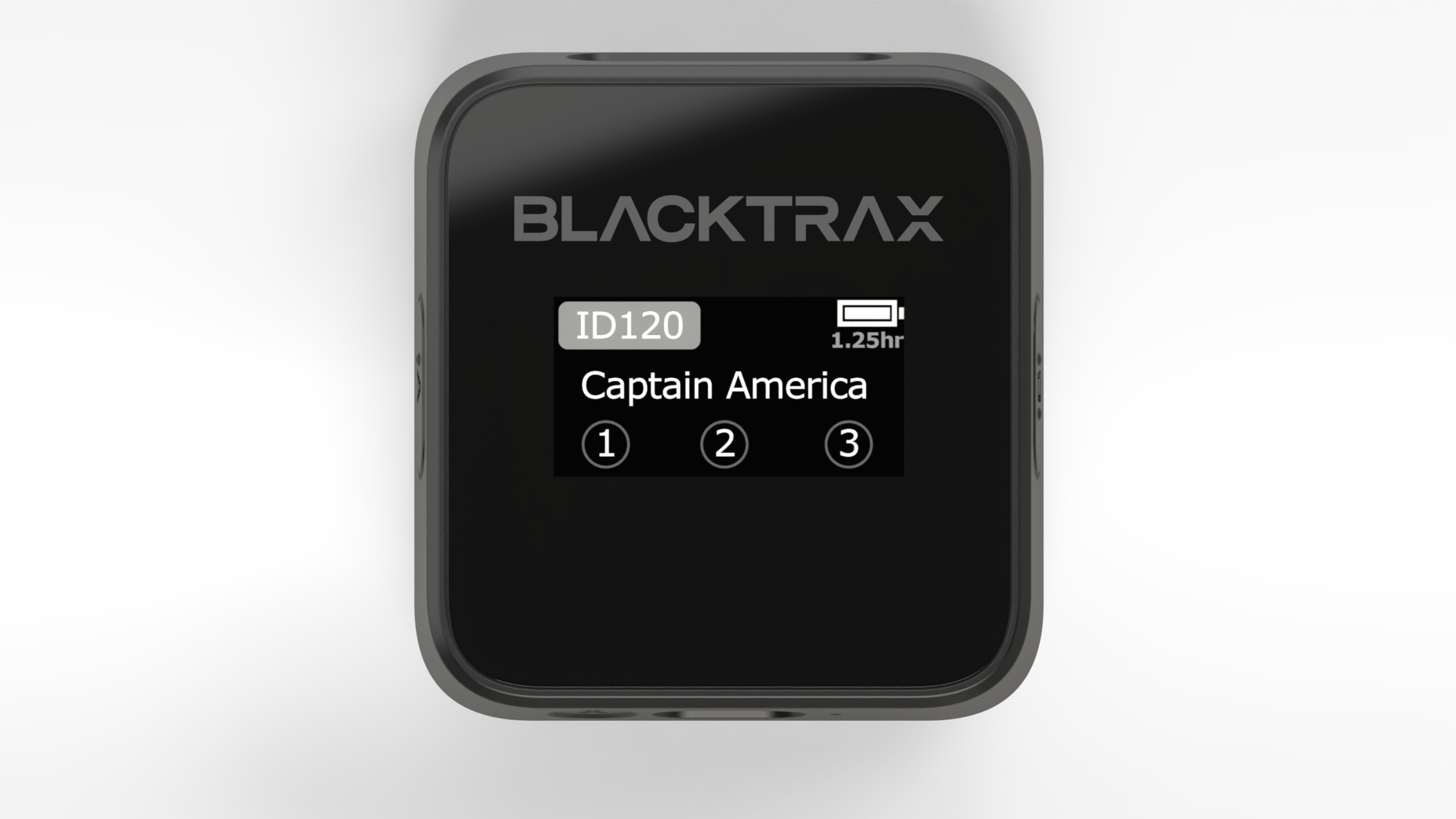
CAST Group arrived with an industrial design in mind for the BlackTrax Beacon 2.0, and PDE built the rest of the product to complement it. On the Eaton TD3100, PDE worked within Eaton's established design direction to deliver a sealed, drop-rated belly-pack controller.

Top-down view of the CAST BlackTrax Beacon 2.0, designed by PDE around the client's industrial design
From the Portfolio

Products We've Designed

Fathom Hub
Retail

Fathom Hub

Fathom™ represents the next generation in Location-as-a-Service (LaaS) technology, utilizing Bluetooth to enhance asset tracking systems with 2m indoor location accuracy. The gateway to Fathom’s Real-Time Location System is the Fathom Hub, a directional Bluetooth radio receiver combined with the subscription-based Fathom Control software platform in the cloud.
View Case Study
TD2100
Industrial

TD2100

The Eaton TD2100 is a pistol-grip wireless machine control designed for operating mobile hydraulic equipment. Built for the job site, it features a rugged IP67-rated enclosure, two-way communication, and a fully customizable button layout, all designed around a handle that stays comfortable through long shifts.
View Case Study
Form, Ergonomics & Finish

Capabilities in Practice

Form & Product Language

Form development that fits the product's environment and says something about its function, from a retail sensor meant to disappear into a ceiling to a gateway meant to be noticed.

Mood boards, hand sketching, CAD massing models, photo-realistic rendering.

Ergonomics & Human Factors

Handhelds and body-worn devices shaped around grip, reach, and contact over a full working day, without giving up sealing or drop resistance.

Full-size models, user evaluation and testing, 3D printing and machining.

Colour, Material & Finish

Surface finish, material, and lighting choices specified for production, including textured and polished surfaces, tinted dead-front faceplates, and backlit graphics.

CMF studies and specification, injection molding, die casting.

FAQ

More Questions We Get Asked

What is CMF in industrial design?

CMF stands for colour, material, and finish: the choices that decide how a product’s surfaces look and feel. It covers the plastic or metal each part is made of, its colour, texture and gloss level, and details such as tinted windows, backlit graphics, and light pipes. PDE starts CMF studies during ideation and delivers a final CMF specification with the manufacturing documentation, so the factory produces the surfaces you approved. On the Fathom Hub, a textured top surface against polished side walls and an illuminated logo give a small enclosure a finished look.

Do you test industrial designs with users?

Yes. User evaluation and testing is part of the Prototyping and Testing phase. Full-size 3D printed or machined models let operators, clinicians, or consumers hold and use the design before the detailed design for production starts, while changes are still cheap. What they find goes back into ideation and concept development.

How do you design a handheld or body-worn device for all-day comfort?

By designing around the hand and body positions the operator holds for hours. On the Eaton TD2100 pistol-grip controller, a recess in the housing lets the operator’s thumb reach the bottom row of buttons without breaking grip. On the Eaton TD1140 pendant, a narrower back profile reduces the contact surface against the operator’s body. Both kept IP67 sealing and drop resistance.

Can industrial design help a product stand apart from a competitor's design?

Yes. Differentiation from existing products can be a design requirement like any other, and it is set during Discovery. The RetailNext Aurora had to stay clearly distinct from a competing two-camera device already on the market, and the design brief treated that as a constraint from the start. Whether a design clears a specific patent is a legal question for patent counsel, but the design work can be steered to give counsel a clear answer.

Does PDE do industrial design for products whose electronics are already developed?

Yes. Industrial and mechanical design are often engaged together for technology that already works. RxNetworks and RetailNext both brought developed sensor technology to PDE, which designed the enclosures that turned them into the Fathom Hub and the Aurora.

What kinds of products does PDE do industrial design for?

Electronic products across retail, industrial, consumer, and medical markets: ceiling-mounted retail sensors and location gateways, rugged wireless machine controls for hydraulic equipment, a consumer stove safety device, and a handheld medical imaging device. The common thread is a product where the enclosure has to hold, seal, cool, or position electronics as well as look right.

Where is PDE located, and do you work with clients outside Vancouver?

PDE is based in Burnaby, BC, in Greater Vancouver, and works with clients throughout North America. A hybrid model and an in-house design lab support both remote and in-person collaboration, including review of physical prototypes.

How does industrial design relate to PDE's other services?

Mechanical Design turns the industrial design into the parts, mechanisms, and structure that make it work and get it built. Electronics Design is the circuit board inside it. For products where design, electronics, and firmware need to be developed together from the first concept, see Full Service Product Development.